How Much Does a 20% Discount Reduce Your Profit?
A smaller price can make a much bigger dent in profit. Here’s the maths to check before your next promotion.
The quick answer
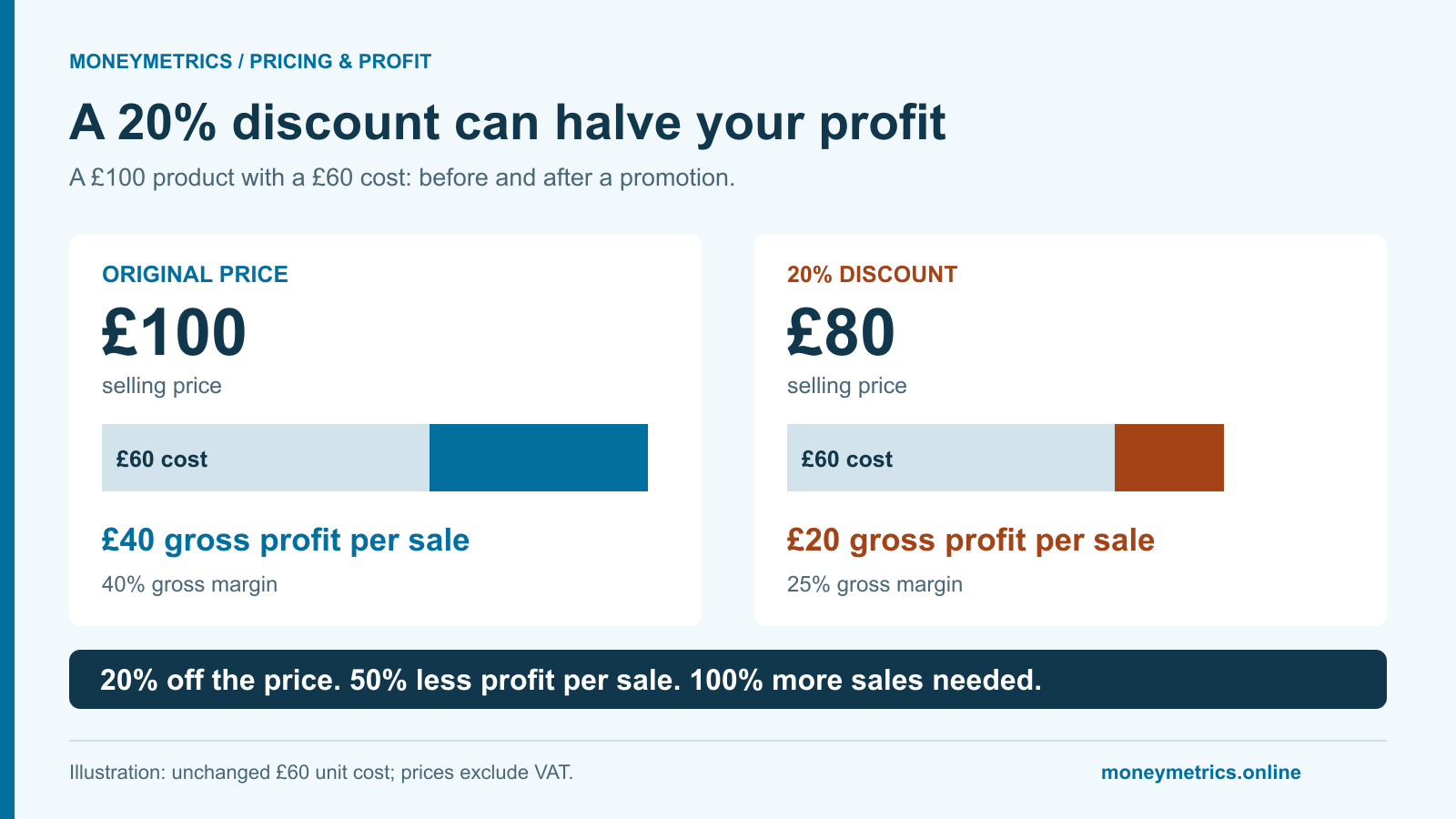
A 20% discount reduces gross profit per sale by 50% if your original gross margin is 40% and unit cost stays unchanged. A product selling for £100 with a £60 cost earns £40 gross profit. Discount the price to £80 and that becomes £20. You need twice as many sales to earn the same total gross profit.
The effect depends on your starting margin. There is no single profit reduction that applies to every 20% discount. A business with a smaller margin has less room to reduce its price.
Check your own discount
Enter your selling price, cost and proposed discount to compare profit before and after.
Use the discount profit calculator →A £100 product: before and after a 20% discount
Imagine you sell an item for £100. Buying or making it costs £60 per item. For this example, that cost stays fixed and prices exclude VAT. We compare gross profit before advertising, overheads and tax.
| Metric | Original | Discounted |
|---|---|---|
| Selling price | £100 | £80 |
| Cost per item | £60 | £60 |
| Gross profit per sale | £40 | £20 |
| Gross margin | 40% | 25% |
| Sales to earn £400 gross profit | 10 | 20 |
The price falls by £20, and gross profit falls by the same £20. But £20 is half your original £40 profit. This is why a 20% price cut can create a 50% profit reduction.
Notice the distinction between profit and margin: profit per sale falls by 50%, while gross margin falls from 40% to 25%, a drop of 15 percentage points. Margin uses the new selling price as its denominator. Use our profit margin calculator to check both amounts.
How different discounts change gross profit
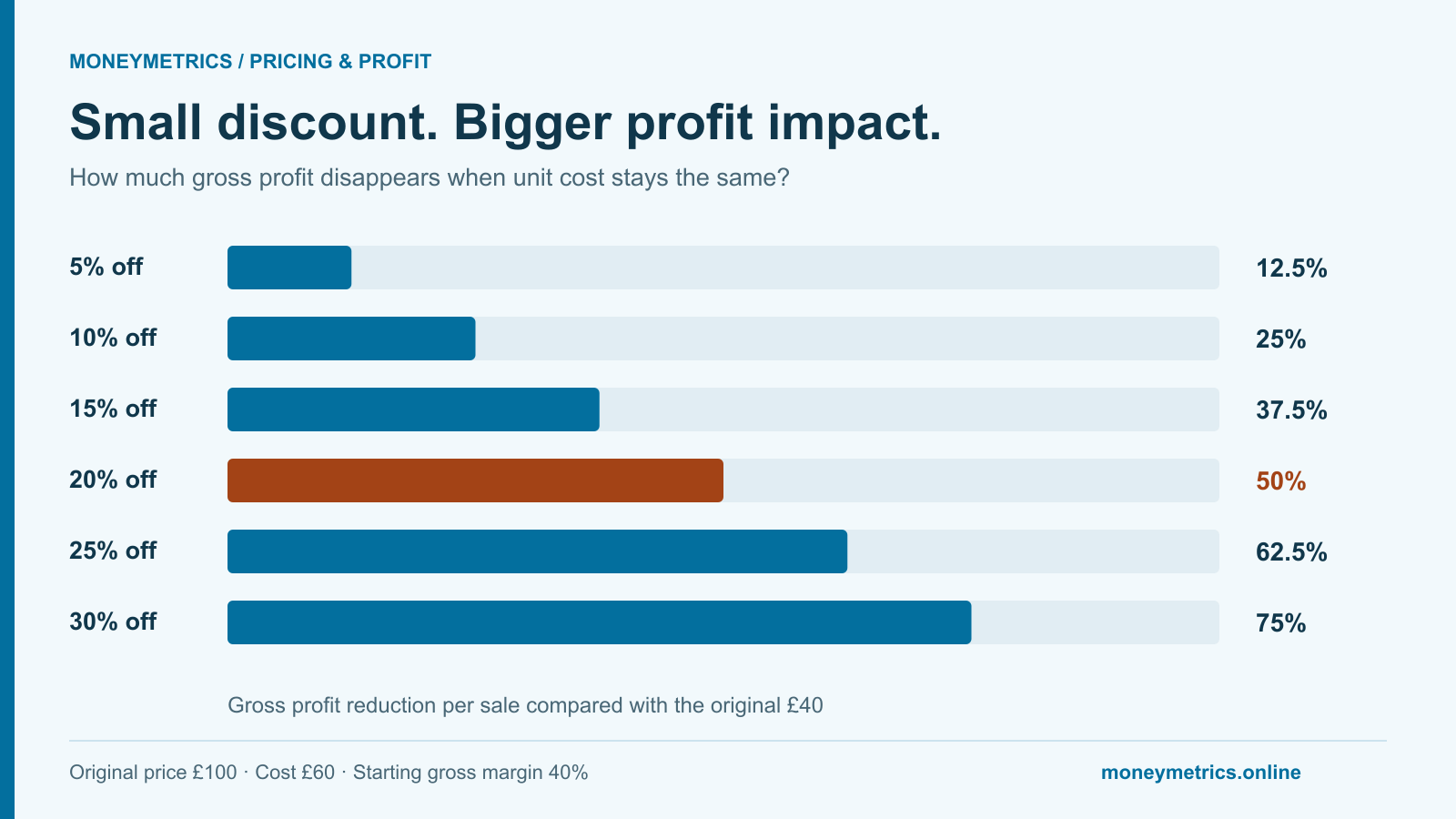
The table and chart below keep the same £100 original price and £60 unit cost. As the discount grows, the cost absorbs more of each sale.
| Discount | New price | Gross profit | Profit reduction |
|---|---|---|---|
| 5% | £95 | £35 | 12.5% |
| 10% | £90 | £30 | 25% |
| 15% | £85 | £25 | 37.5% |
| 20% | £80 | £20 | 50% |
| 25% | £75 | £15 | 62.5% |
| 30% | £70 | £10 | 75% |
| 40% | £60 | £0 | 100% |
At a 40% discount, the £60 selling price only covers the £60 item cost. Gross profit is zero. Selling more at that price cannot recover the original gross profit, and any additional selling costs would create a loss.
How many extra sales do you need after a discount?
Compare total profit, rather than just orders or revenue. If you originally sold 100 items at £40 gross profit each, you earned £4,000 gross profit. At £20 per item, you need 200 sales to earn that same £4,000.
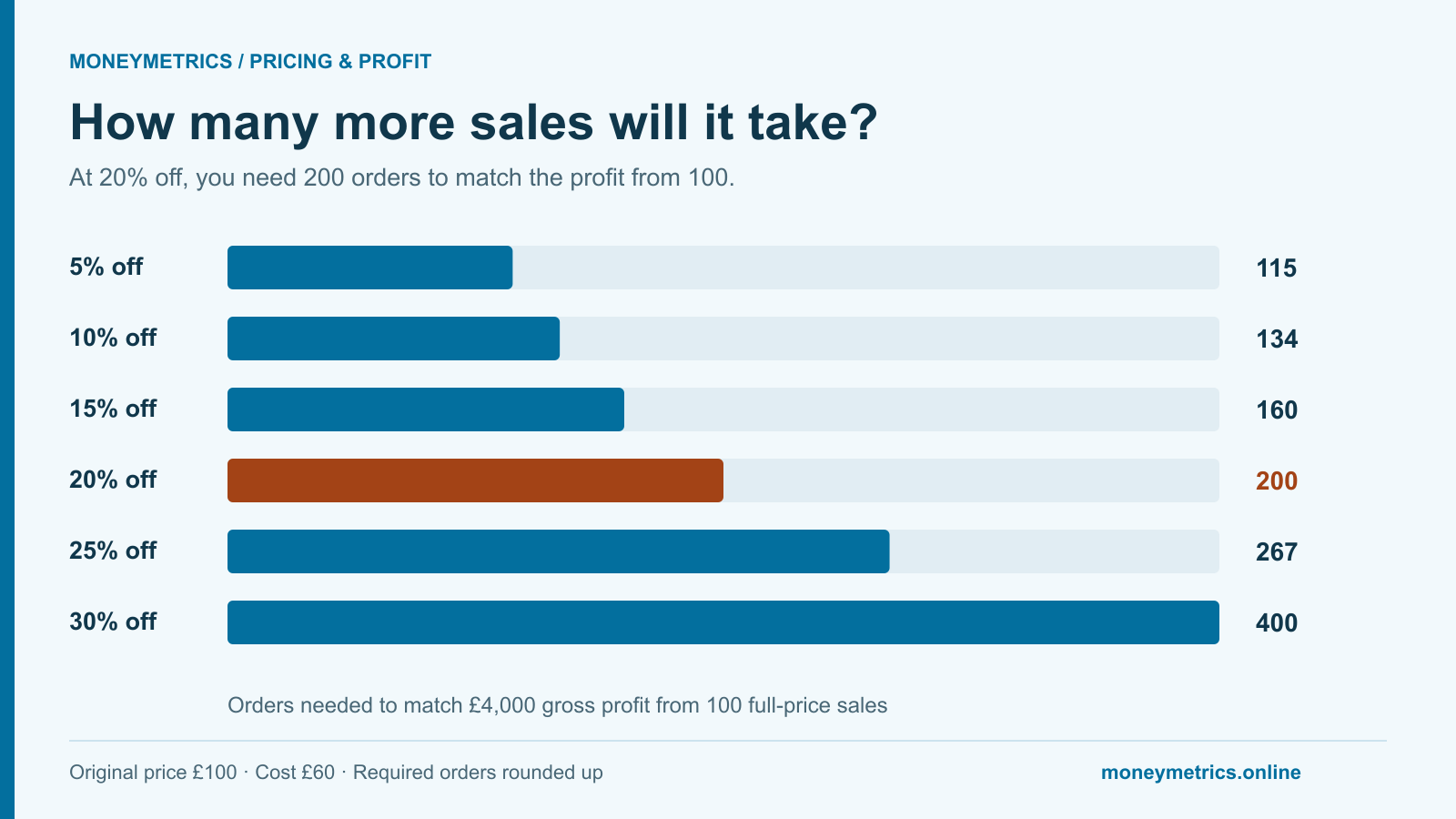
A smaller discount can make a substantial difference. At 10% off, you earn £30 per item and need 134 orders to match the original £4,000. At 30% off, you earn £10 per item and need 400 orders. Consider whether your audience, stock and fulfilment capacity can support the increase.
These are arithmetic targets, not sales forecasts. The calculation does not predict how customers will respond to a price change.
The formulas for discount impact on profit
Let P be the original selling price, C the unchanged unit cost and d the discount as a decimal. For example, a 20% discount is 0.20.
- Discounted selling price
- P × (1 − d)
- Original gross profit per sale
- P − C
- Discounted gross profit per sale
- [P × (1 − d)] − C
- Gross profit reduction (%)
- (P × d) ÷ (P − C) × 100
- Extra sales needed (%)
- {[(P − C) ÷ ([P × (1 − d)] − C)] − 1} × 100
When original gross margin and discount are expressed as decimals, the last formula simplifies to d ÷ (margin − d) × 100. With a 40% margin and a 20% discount, that is 0.20 ÷ (0.40 − 0.20) × 100 = 100% extra sales.
The profit reduction percentage requires positive original profit. The extra-sales formula requires positive profit after discount. If your discounted price is at or below unit cost, there is no sales volume that restores positive original profit under this model.
Five checks before running a promotion
- Use the costs that change with each order. Packaging, payment processing, delivery subsidies and marketplace fees may reduce what you keep. If a fee is a percentage of the selling price, recalculate it at the discounted price rather than treating it as fixed.
- Keep VAT treatment consistent. Compare prices and recoverable costs on a consistent basis. If VAT applies, our VAT calculator can help separate inclusive and exclusive amounts; check the treatment for your transaction.
- Set a profit target. Work out the additional orders needed, then account for any extra advertising or staffing costs. Revenue growth alone does not tell you whether the promotion worked.
- Consider who receives the discount. A promotion also reduces profit on orders from customers who would have paid full price. Track incremental sales where possible.
- Compare alternatives. A smaller discount, a bundle or a minimum-spend offer may produce different results. Include the cost of any free item or shipping benefit in the comparison.
Discounting can still serve a purpose: clearing stock, introducing a product or encouraging a first order. Evaluate that purpose alongside the immediate profit cost. Do not assume future repeat purchases will cover a loss without evidence.
Common questions about discounts and profit
Does a 20% discount always halve profit?
No. It halves gross profit per sale at a starting gross margin of 40%, assuming unchanged unit cost. At a starting 50% margin, the same discount reduces gross profit by 40%. At a starting 25% margin, it reduces gross profit by 80%.
Is a 20% discount the same as a 20% lower margin?
No. A discount is measured against the original selling price. Gross margin is gross profit divided by the selling price. In our example, a 20% discount takes margin from 40% to 25%.
What is the largest discount I can offer without losing money?
In the simplified model, the original gross margin is the discount at which price equals unit cost. At a 40% starting margin, 40% off leaves zero gross profit. A practical limit must also account for other costs and the profit you need to retain.
Does this work in dollars or euros?
Yes. The percentage relationships stay the same when all amounts use one currency. The pounds in this guide are illustrative amounts, not exchange-rate conversions.
Put your promotion to the test
Start with your current price and cost. Compare a smaller discount with your planned offer before committing to it.
Calculate your discount’s impact →Sources and methodology
All figures and charts are original MoneyMetrics calculations using the formulas above. Values use unrounded calculations; required orders round up to the next whole sale. The model assumes constant unit cost, unchanged product mix and no additional fixed costs. It excludes overheads, advertising, returns and tax unless included in your own cost inputs.
For background on pricing terminology, see Xero’s explanation of margin and markup. For pricing approaches and promotional trade-offs, see Shopify’s guide to discount pricing.
Written and calculations checked by MoneyMetrics, 3 November 2026. Educational information for business planning.
You may share these original charts with attribution and a link to this guide.